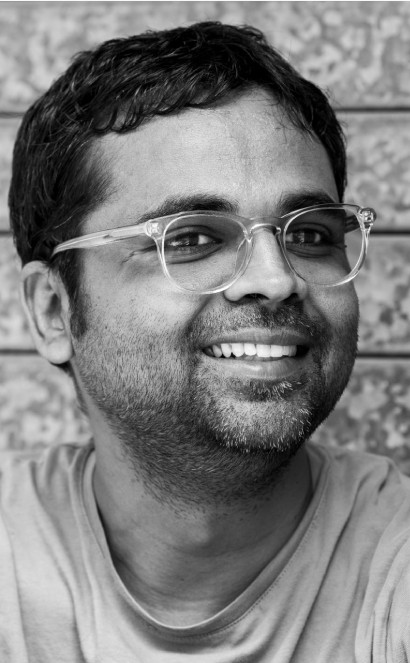
Born in 1980, T. Venkanna has established a reputation as one of the most exciting, versatile and unconventional artists of his generation, thanks to his powerful and strident imagery, as well as his prodigious output. He holds a Master of Fine Arts (MFA) specialising in printmaking from the Faculty of Fine Arts at M.S. University, Baroda, as well as a Bachelor of Fine Arts (BFA) specialising in painting from J.N.T.U., Hyderabad, where he was awarded a gold medal. His works are held in major collections in India, Japan, Russia, the Netherlands, France, the United States and the United Kingdom, including the Burger Collection in Switzerland, the Swagemakers Collection in the Netherlands, the Karen and Robert Duncan Collection in the United States, and the Kiran Nadar Museum of Art in India, amongst many others.
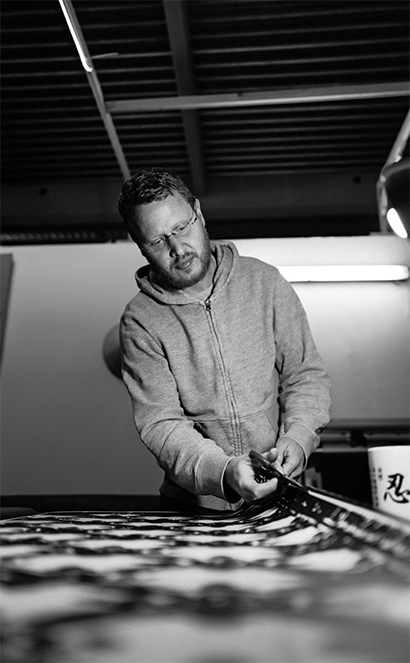
Pierre Roy-Camille is a French artist born in Martinique in 1979. Trained at the École nationale supérieure des Beaux-Arts in Paris, he has developed a practice that combines drawing, painting, digital media and mural painting. His work, informed by his dual heritage spanning Martinique and France, explores the links between tropical landscapes, memory, illusion and the imagination.
His work has been exhibited in France, Martinique and the United States, and is held in several public and private collections.
In 2022, Pierre Roy-Camille joined the Kalhath Institute in Lucknow for a research and creative residency, with the support of the French Institute in India. Described by the artist as a « very enriching and productive residency », this immersion gave rise to a new body of work combining painting and Indian embroidery. Developed in collaboration with the master embroiderers of Lucknow, this project marks the beginning of an ongoing dialogue between the artist and the Kalhath Institute, embodying the Foundation’s mission: to foster long-term collaborations between contemporary artists and exceptional craftspeople.
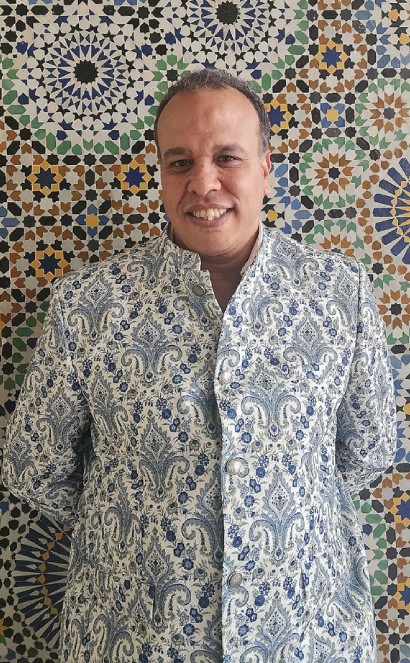
Yassine Balbzioui, a Moroccan multidisciplinary visual artist born in 1972, is known for his neo-expressionist works which explore the themes of human animality, derision and the grotesque, often using the mask as a central motif. A graduate of the Écoles des Beaux-Arts in Casablanca and Bordeaux, he draws his inspiration from everyday life, cinema, theatre and folklore. His work has been exhibited internationally, notably at the Museo Reina Sofía in Madrid and at the 13th Dak’Art Biennale. During his residency as part of the Villa Swagatam programme Balbzioui created 11 works combining drawing, painting and embroidery, inspired by the fairy tales of Lucknow, in collaboration with 21 craftspeople from the Kalhath Institute.
Kalhath took the initiative to exhibit these works following his residency, in collaboration with Es Saadi Marrakech Resort in Marrakech, as part of the 1-54 Contemporary African Art Fair Marrakech. In 2024, his embroidered works Twin Bubbles made their European debut at the Subversive Threads Festival, in collaboration with Neuer Kunstverein Mittelrhein, at the Artist Residency Schloss Balmoral.
‘Through my work, I engaged in a sort of “ping-pong” with the craftspeople: I would start a design—ink interventions on the fabric—then the craftspeople would embroider it, and I would then transform the design again, and so on throughout the creative process. The starting point is a bestiary of half-human, half-animal creatures, loosely inspired by fairy tales, but also by the history of the city of Lucknow and its embroidery techniques.” — Yassine Balbzioui
The artist spent 12 weeks on an artist-in-residence programme at the Kalhath Institute, which further enriched his artistic exploration and cultural exchanges.
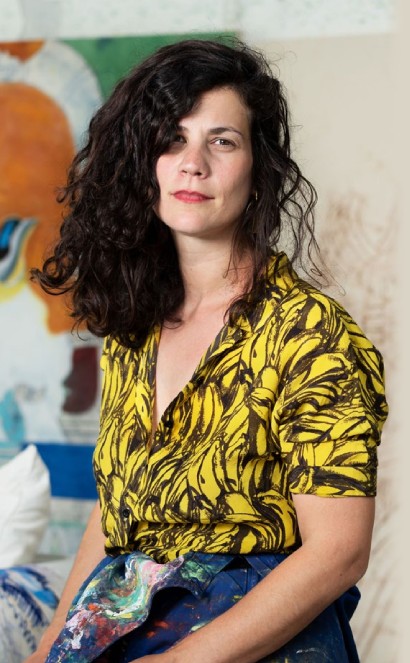
July Ancel, a graduate of the École des Beaux-Arts in Paris, has developed a distinctive identity as a painter through her travels in China, Mexico, Thailand and Turkey. Her ‘nomadic painting’, imbued with myths, symbols and gestural intuitions, reflects her exploration of ritualistic compositions. Recognised with awards such as the Antoine Marin Prize, the Yishu Prize and a scholarship from Casa Velázquez, her work forms part of major private collections in China, France and South America. During her residency as part of the Villa Swagatam programme, Ancel immersed herself in local culture and craftsmanship, collaborating with 21 skilled artisans from the Kalhath Institute. Together, they created 23 unique works that combined her oil painting techniques with traditional Indian embroidery and weaving. This collaboration led to her solo exhibition Exotic Weavings: July Ancel’s Journey Through India, held at Gin Huang Gallery in Taipei from in 2024, showcasing a rich fusion of French and Indian artistry. Her artistic journey was enriched by a sixteen-week residency at the Kalhath Institute, which allowed her to deepen her exploration and cultural exchanges.
“India is a destination I have been thinking about for a long time. I find it fascinating: its folklore, traditions, symbols, spirituality and legends resonate in my mind. I had been dreaming of this trip. It was essential, at this stage in my life, to give substance to my artwork and to draw inspiration for new images through collaboration with karigars, the textile artisans.” – July Ancel.
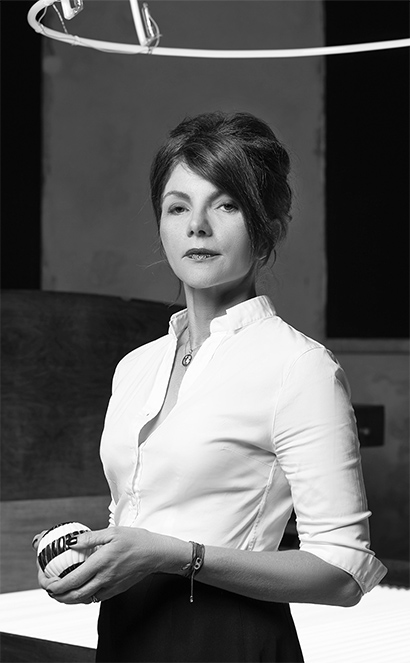
Amina Benbouchta is a Moroccan artist born in 1963 in Casablanca, where she lives and works between Morocco and France. A major figure in Morocco’s contemporary art scene, her multidisciplinary practice moves between painting, sculpture and installation, exploring the relationships between memory, identity, social structures and the symbolic power of objects. Through a singular visual language, she examines questions of gender, perception and cultural narratives. Her work has been exhibited internationally through museums, institutions and biennials, including the Mohammed VI Museum of Modern and Contemporary Art, MACAAL, the Stedelijk Museum Schiedam, the Cairo Biennale and the Alexandria Biennale. Her works are held in numerous public and private collections.
In 2024–2025, following an invitation from the Kalhath Foundation, Amina Benbouchta undertook a production residency at the Kalhath Institute in Lucknow. Working alongside twenty master embroiderers, she developed a new body of work combining her pictorial language with Indian hand embroidery. Presented by the Kalhath Foundation as a Special Project at the 1-54 Contemporary African Art Fair Marrakech 2025, the works extend her exploration of memory, gender and cultural narratives through a dialogue between contemporary art and exceptional craftsmanship.
The works selected for the fair sold out and entered private collections across Morocco, the Middle East, Europe and the United States.
Since then, other works from the series have continued to circulate through major cultural and artistic events in Morocco and internationally. In 2025, embroidered works by the artist were presented in Aïta: Fragments poétiques d’une scène marocaine at the Frac MÉCA, Bordeaux, an exhibition exploring the vitality and plurality of Morocco’s contemporary cultural scene. They will also be featured in upcoming collective exhibitions, where embroidery continues to serve as a medium through which memory, craftsmanship and contemporary artistic practice are brought into dialogue.
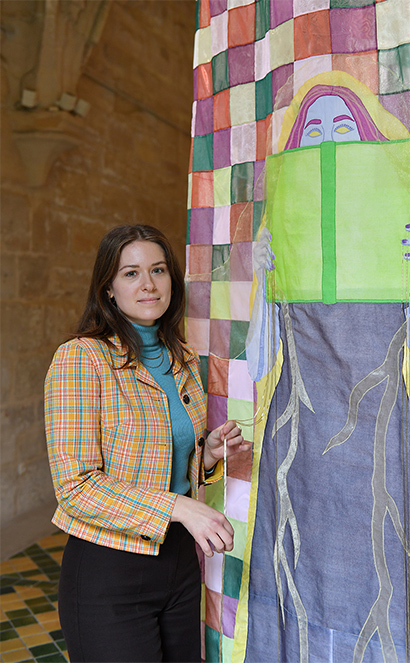
Lauren Januhowski (b. 1992, Houston, Texas) develops a body of work that interweaves autobiographical narratives with the stories of the women around her, constructing textile assemblages through monotype printing, sewing, embroidery, and weaving. A graduate of The Cooper Union (2015) and the École des Arts Décoratifs de Paris (2020), her meticulous, layered process connects her to her family’s textile heritage while questioning the emotional and societal challenges that women face. Januhowski’s work has been exhibited internationally, including at Magasins Généraux, Galerie Christian Berst, Art Basel, and in recent solo shows with BimBam Gallery and Marquesa Gallery. Her ongoing artistic research has been deeply enriched by prestigious residencies, notably at the Abbaye de Maubuisson (Saint-Ouen-l’Aumône, France) and at the Kalhath Institute (Lucknow, India) as part of the Villa Swagatam program.
Kalhath Project:
During my two-month residency at the Kalhath Foundation through Villa Swagatam, I immersed myself in India’s rich textile history, collaborating with master artisans to deepen my understanding of embroidery and transform my approach to image-making. The resulting body of work reflects on personal and spiritual journeys, the complex experience of being a woman in a foreign space, and the architectural and cultural tapestry of Lucknow. Exploring the universal transmission of women’s knowledge and emotions beyond words, these pieces draw on recurring motifs of protective veils, community circles, and symbolic waters. Ultimately, my residency with Kalhath served as a bridge between past and present, allowing us to participate in a shared language of artistry that paired my own storytelling with the artisans' profound, generational knowledge of embroidery.
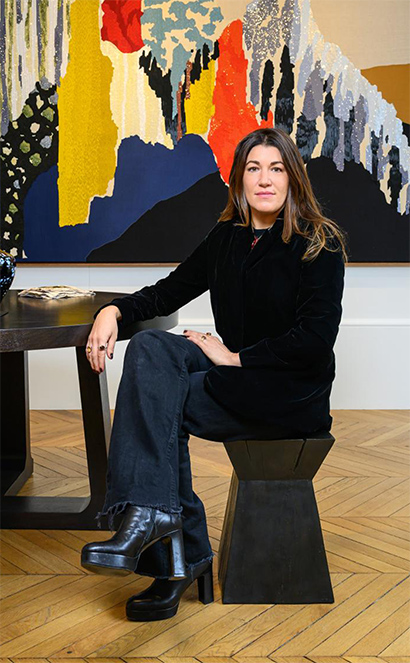
Born in 1990 in Clamart, France, Pauline is a contemporary artist based between Paris and Lisbon. Influenced by her artistic family, she graduated from the Beaux-Arts de Paris in 2014. Guerrier’s work spans various media and themes, including ecology and superstition, drawing on collaborations with artisans worldwide. She exhibits at major international art fairs and institutions, including Art Paris and the Cobra Museum. She is represented by Foco Gallery in Lisbon and collaborates with RX Gallery and Clavé Fine Art Gallery in Paris.
“My creative process is nourished and enriched through the observation and discovery of specific techniques linked to particular places and craftspeople. I am drawn to spaces steeped in history, beliefs and legends that manifest themselves fluidly in everyday life. I have incorporated the artisanal techniques I have encountered on my journey as a means of expression, seeking to imbue everyday tools with new meanings. The body, space, time and remnants are subjects that I continually interconnect.” – Pauline Guerrier
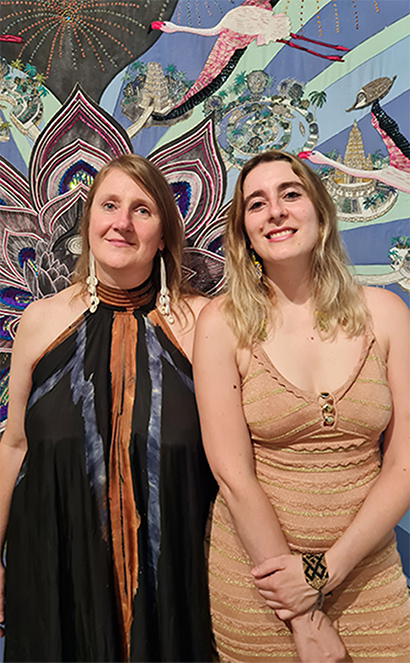
The duo Cécile Palusinski (writer and sound designer) and Elsa Mroziewicz (multidisciplinary visual artist) have developed an artistic approach that combines writing, drawing, embroidery, sound poetry, and augmented reality. Their immersive works explore the connections between mythology and biodiversity through field research conducted in collaboration with artisans, researchers, and local communities. Their projects, including Arbres Mondes, La Forêt universelle, Villes flottantes, and Le Sacre des oiseaux, offer new narratives in which traditional craftsmanship engages with contemporary technologies.
Villes flottantes was created during several residencies through the Institut français network, including one at the Villa Albertine.
Elsa Mroziewicz's residency at the Kalhath Institute in 2025 marked a decisive milestone in this research. In collaboration with the Institute's artisans, La Forêt universelle and Villes flottantes were reimagined through embroidery, creating a dialogue between the slow, labor-intensive nature of textile craftsmanship and the rapid pace of augmented reality. This experience gave rise to a new form of expression in which material, sound, and digital imagery complement one another. Rooted in co-creation, the transmission of craftsmanship, and intercultural exchange, this collaboration places artisans at the heart of the creative process and continues today to inspire their embroidery projects developed in India, Brazil, and Morocco. Their work resulting from the residency has been exhibited at the Grand Palais (ChangeNOW, Paris), the Château de Saumur (France), the MAC Niterói, the Centro Cultural Vale Maranhão, and the Cais do Sertão Museum (Brazil).
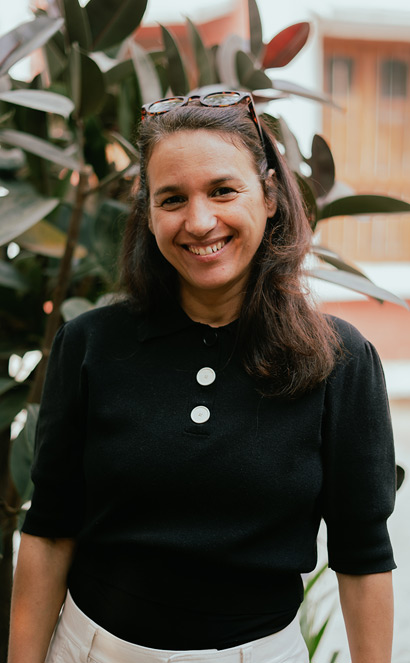
Dalila Dalléas Bouzar was born in 1974 in Algeria and lives and works in Bordeaux, France. She trained in biology before discovering painting and honing her skills at the Beaux-Arts in Paris. In her work, she explores individual and collective memory, particularly in relation to Algerian history. Beginning with drawing and painting, her practice has expanded to include textile art and performance, through which she deconstructs the clichés surrounding the representation of Arab women whilst questioning the role of the artist within these representations. By depicting marginalised identities, she seeks to highlight the power dynamics inherent in Western representations within art history.
“During my residency at the Kalhath Institute last year, I created an embroidered burnous. The burnous is a sleeveless coat with a pointed hood worn by men in the Maghreb. It is a traditional garment and an emblematic symbol in Algeria. It stands for dignity, social status and nobility. The burnous was exhibited at a group exhibition titled OVERTIME (Prolongation) at the Institut des Cultures d’Islam in March 2026. The exhibition uses football as a means of exploring the role of young men from immigrant families in French society. Whilst collaborating with the embroiderers, I loved that their creativity and knowledge of embroidery enriched the project so much.” — Dalila Dalléas Bouzar
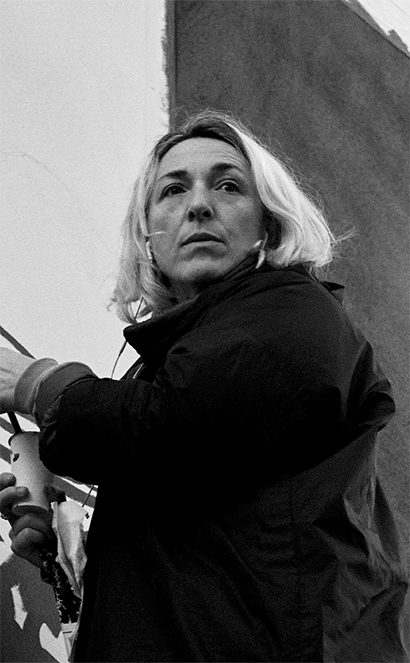
Deborah is a multidisciplinary visual artist and art director based in Paris. After studying visual communication at the École Nationale Supérieure des Arts Décoratifs in Paris, Deborah moved to India in 2005, drawn to its rich heritage of craftsmanship. Enriched by her travels and local crafts, her design philosophy has led to collaborations across fashion, lifestyle, homeware and entertainment. Spatial and cultural immersion also inform Deborah’s visual art practice: keen observation gives way to fluid abstraction, capturing nebulous memories of place and time through landscapes, portraiture, architecture and the natural world. She continues to collaborate with brands in India, whilst expanding her design and art practice.
“During my residency as part of the Villa Swagatam programme, it feels like the ideal place to explore, experiment with materials and techniques, and to develop a new artistic language in dialogue with craftspeople. The project values slowness, the passing on of knowledge, and the traditional craft as an evolving artistic practice. It is truly a collaborative process in which the craftspeople and I learn from one another, and traditional, skilful techniques lie at the heart of creating a collection of unique, contemporary pieces.” — Deborah Di Fiore.